Showing posts with label casserole. Show all posts

Sunday, 2 February 2014

Can opener cuisine

If you're like me, you watch a lot of cooking shows on TV.

What always strikes me as interesting, though not necessarily interesting in a good way, is that cooking with canned (or frozen, or otherwise processed) food is always presented as a "challenge" to professional chefs.  What makes me even more frustrated is the disgust with which they discuss these ingredients: these are things that they "wouldn't be caught dead cooking" if they weren't participating in this particular reality TV show.

First let me say: I get it.  You can do a lot more things with fresh food than you can with things that have been processed in some way.  But let's face it...this kind of "I only cook with fresh organic produce and meat and wouldn't touch canned or processed food with a ten-foot pole" way of thinking is not accessible to your average home cook, either because they do not have access to them, or (more likely) because eating this way can be quite expensive.

So today I'm going to let you in on a little secret: one of my favourite casseroles is made with (gasp!) mostly canned/otherwise processed ingredients.

This is a casserole that my mom used to make when I was little, and I've made a few modifications to the recipe since then.  I love it because the sauce is cheesy and delicious, and it's a complete meal that (1) can be ready in 30 minutes or so, (2) can be made the day before and just re-heated for dinner, and (3) most of the ingredients are things that you can keep in your cupboard/fridge/freezer for a rather long time (making it a great "I didn't have the time/desire to go shopping" meal).

Ingredients
-2 cans of Campbell's "Cream of ________" condensed soup.  I like to use one can of cream of celery and another of cream of broccoli, but feel free to choose any two that you like.
-1 cup of milk
-6 cheese slices (alternatively: use grated cheese, though it doesn't melt quite as nicely)
-3 cans of turkey flakes (you could also use tuna or ham), drained
-2 cups frozen peas
-1 pound of penne (or any other pasta)
-1 cup grated cheddar cheese (alternatively: use more cheese slices)

1) Cook the pasta per the directions on the package.  Drain, and set aside.

2) Combine the condensed soups and milk in a pot over medium-low heat.  Add the cheese slices and cook until they have melted.  Add the turkey flakes and peas.

3) Add the soup mixture to the pasta; mix well.  Pour into a greased 9x13 baking dish.

If you're making this casserole ahead, after step (3) put the casserole in the fridge.  I've left it there for as long as 24 hours (though I wouldn't want to leave it much longer than that).

4) If you'd like to eat right away, sprinkle grated cheese over the top at bake at 350 degrees F for 20 minutes or so (until bubbly).  If you don't have grated cheese and are topping your casserole with cheese slices instead, add the cheese during the last 5 minutes of baking time.  If you have made the casserole ahead it may need a little extra time in the oven...

As always...enjoy the hot, bubbly (admittedly processed and full of sodium) goodness!

I must apologize...I don't have a picture of this particular casserole, mostly because I tend to dig right in after I put it on the plate (seriously...it's that good).  But these are the ingredients, and I always have them on hand for those "Oh crap I don't really want to go to the store" kind of days....

Sunday, 15 December 2013

Low & slow

It's snowing today.  I don't know about you, but I think that days like this call for stew.

While it is quite easy to make a good stew in a relatively short period of time, nothing really beats the taste and texture of something that has been braising for hours.  "Braising" involves cooking a piece of meat in some liquid at a low temperature (just barely simmering) for a very long time (ideally several hours), resulting in meat that is oh so tender and flavourful.

At first glance this recipe seems really involved...but then you realize that the meat is going to spend three hours in the oven, so the prep time isn't really that bad.  The meat portion of this recipe could easily be made in a slow cooker (though slow cookers aren't that great at baking biscuits...if you wanted to make the biscuit topping you would have to do that separately in the oven).  Also, since this recipe comes from a cookbook dedicated to beer that is what makes up the braising liquid...if you're not a beer fan you could try substituting an equivalent amount of wine, beef stock, or onion soup (from one of those powdered onion soup mixes).  Basically: braise your meet in something that you like the flavour of, because that is what it's going to taste like at the end.

Ingredients

Beef
-2 lb beef roast, cut into cubes.  Because you're going to be braising this for quite a long time you can go with one of the cheaper cuts...those cuts are usually less expensive because they have a lot of connective tissue/fat and are difficult to cook (and are therefore the perfect cut for this kind of braise)
-3 tbsp butter
-4 slices of bacon, cut into 1 inch pieces
-1 onion, diced
-2 cups of English brown ale (Newcastle is a readily available variety).  If you're using a roast that is bigger than 2 lbs, increase the amount of beer.
-2 cups beef or chicken broth
-3 or 4 sprigs of fresh thyme
-1 bay leaf
-12 to 14 cremini mushrooms, halved
-1/2 cup frozen green peas
-1 large carrot, diced
-salt and pepper to taste

Biscuit topping
-1/2 cup milk
-1 tsp lemon juice
-1/4 cup melted butter
-2 cups all purpose flour
-2 tsp baking powder
-1/2 tsp baking soda
-1 tsp salt
-1/2 grated cheddar cheese
-1/2 cup English brown ale (helps the biscuits rise, so if you're not going to be using the beer in this particular instance you will want to find a different biscuit recipe.  Alternatively, you could just top the beef with mashed potatoes, shepherd's pie style)

1) Heat the oven to 300 degrees F; set the rack in the second lowest position.

2) On the stove, over medium heat, melt 2 tbsp of butter in a large Dutch oven (if you do not have a Dutch oven a heavy stainless steel pot will do...it just needs to be something with a fitted lid that you are able to put into the oven.  If you are going the slow cooker route a frying pan will also do the job.)  Divide the beef into at least two batches and sear the outside of the pieces until deep brown and caramelized (the goal here is not to cook the beef all the way through, it is to add some nice browned flavour).  Remove from the pan and set aside.

It's tempting to add all the beef at once and just stir it around until it is brown...but don't.  If you overcrowd the beef it will actually steam instead of searing, and you won't get that delicious browned flavour into your meat.  It takes more time, but it's totally worth spreading out the pieces and taking the time to brown each piece.
3) Add the onions and bacon.  Cook, stirring occasionally, until the bacon has begun to crisp.  Remove the onions and bacon (drain off some of the fat if there is lots in there) and add the beer to deglaze the pan (use a wooden spoon to scrape all the brown bits off of the bottom).  Add the browned beef, onions, and bacon back into the Dutch oven.  Add the broth, thyme, and bay leaf.  Cover and move to the heated oven.  Cook with the lid on for two hours.  Then remove the lid and cook, uncovered, for one more hour (if at any point the pot dries out add more liquid).

It will be in the oven for three hours, and you don't have to stir it, giving you time to do other things.
If you're going the slow cooker route, follow the above directions as far as using the beer (or whatever liquid you have chosen) to deglaze the pan.  However, instead of adding everything back into the Dutch oven, put all of the ingredients into a slow cooker and cook on low for 6 to 8 hours.

4) During the final hour of uncovered cooking, prepare the mushrooms and the biscuit topping.  For the mushrooms, melt 1 tbsp butter in a frying pan over medium heat.  Add the mushrooms and toss to coat.  Cook until they have shrunk noticeably and have turned dark golden brown; set aside.

For the biscuit topping, start by combining the milk and lemon juice in a small bowl; let stand at room temperature for 15 minutes.  Meanwhile, whisk together the flour, baking powder, baking soda, salt, and cheese.  Add the melted butter and beer to the milk and lemon juice mixture, then pour the wet ingredients into the dry ones and mix until just combined.

5) After the hour of uncovered cooking, remove the thyme and the bay leaf from the Dutch oven.  Increase the oven temperature to 400 degrees F.  Add salt and pepper to taste, then stir in the frozen peas, diced carrots, and mushrooms.  Drop the biscuit batter over the top of the stew.

Leave some room around the edges for the steam to escape.
Return the pot to the oven and cook for another 45 minutes or so (until the biscuits are nice and brown).  Let stand for 15 minutes until serving.

If you've decided to go the slow cooker route you have a couple of options for the biscuit step.  First, you could omit them all together and just serve your stew with mashed potatoes.  Second, you could choose a different biscuit recipe (I've provided a nice one here) and just serve them on the side.  Finally, after mixing in the veggies you could transfer everything from the slow cooker to a 9x13 baking dish, cover with the biscuits, and bake as directed (400 degrees F for 45 minutes, or until brown).  The choice is yours!

Letting it stand is the hardest part, because by the time you get it out of the oven that final time you've been subject to the delightful aroma for hours.  Dig in and enjoy your warm (and comforting) stew!

Sunday, 29 September 2013

Two of my favourite things

It's no secret that I love macaroni and cheese.  I've dedicated not just one, but two blog posts to the subject...and this will be the third.  Another not-so-secret fact about yours truly?  I like to drink.  Not just anything mind you.  I like the flavours that you can find in different alcohols: like the citrus in white beer, or the berries in red wine.  So, when I came across a recipe that combined the deliciousness of macaroni and cheese with the scrumptiousness of stout I had to give it a go!

Ingredients
-500 g uncooked rotini pasta
-2 tsp canola oil
-200g hot Italian sausage
-1 large onion, diced
-3 tbsp all purpose flour
-1/2 tsp black pepper
-1/8 tsp salt
-1 bottle of stout (341 mL)
-1/2 cup milk
-80g each grated cheddar cheese and cubed Velveeta (or other processed offering...makes for a very creamy sauce)
-1 1/2 cups frozen green peas

1) Preheat oven to 450 degrees F.  Grease a 9x13 casserole dish

2) Cook pasta according to package directions; drain.

3) While pasta cooks, heat a large saucepan over medium high heat.  Add oil, swirl to coat.  Remove casing from sausage.  Add sausage and onion to pan; cook 6 minutes, stirring to crumble sausage.  Add flour, pepper, and salt; cook 1 minute, stirring frequently.  Stir in beer; bring to a boil.  Cook 3 minutes (until thick and bubbly).  Remove from heat.  Add milk and cheeses, stirring until smooth.  Stir in pasta and peas.  Spread into prepare baking dish and bake for 10 minutes (until lightly browned).

Looks yummy....tastes good too.
It doesn't look like your typical plate of macaroni and cheese...and it doesn't taste like it either.  The stout gives the sauce a very interesting flavour that I would describe as "mushroom-y" (what I believe the professionals call "umami").  Next time, I think I would swap the cheddar in for something like Swiss...I think that nutty kind of flavour would go well with the stout.  I might also choose a different kind of sausage: while I love sausages of the hot Italian variety I found that I couldn't really taste the spice (which is kind of the point of hot Italian sausage).  The above recipe would probably work just as well with ground beef, or a most lightly flavoured pork or turkey sausage.

Or a few red pepper flakes.  Because everything is better with red pepper flakes.

Sunday, 15 September 2013

La-la-lasagna!

Homemade lasagna is a showstopper: beautiful layers of tomato sauce and pasta, all topped with bubbly cheese.  It's a great dish for company...and it's also one of those things that you can make ahead and freeze.

Make-ahead meals are fantastic for those of us that don't have a ton of time on our hand but still want to eat delicious food.  All you need to do on those lazy days is pop whatever you have in the freezer straight into the oven and bam!...great food, no work.  Even better: freeze your lasagna in one of those disposable roasting pans you can buy at the grocery store and you've got a great meal with nearly no dishes.

Don't let the number of ingredients and steps scare you.  It might seem like a lot of work, but there's actually quite a bit of waiting around.  Also: it's totally worth it.

Ingredients (for one 9x13 lasagna.  Double to make one lasagna now and another one later.)
-500g lean ground beef (or any ground meat of your choice.  Half beef/half italian sausage is especially delicious)
-1 onion, diced
-2 cloves garlic, minced
-1 tsp dried oregano (or 1 tbsp fresh)
-1/4 tsp crushed red pepper flakes
-1 jar of your favourite pasta sauce (alternative: use 2 jars of pasta sauce and omit the diced tomatoes)
-540 ml can of diced tomatoes with Italian herbs (or this delicious marinara sauce...I keep bags of it in the freezer)
-2 tbsp dried basil (or 1/3 cup fresh)
-1 tbsp balsamic vinegar
-1/2 tsp black pepper
-12 uncooked lasagna noodles (12 is a guess based on how many noodles I usually need...use as many as you need for 3 layers)
-2 cups ricotta cheese
-300g frozen spinach, thawed, squeezed dry, and chopped
-1/3 cup grated parmesan cheese (or romano, or asiago.......)
-1 egg
-1 1/2 cups grated mozzarella

1) Preheat your oven to 375 degrees F and spray a 9x13 baking dish (set aside).

2) Make the sauce.  Add beef, onion and garlic to a large pot; cook over medium heat until meat is no longer pink.  Add oregano and crushed red pepper flakes; cook for 1 more minute.  Add pasta sauce, tomatoes, basil, vinegar, and black pepper.  Bring to a boil, then reduce heat to low and simmer for 20 minutes.

3) While the sauce is simmering, cook the lasagna noodles.  Tip: I don't like to cook mine all the way through at this stage...if you leave them ever so slightly underdone they're easier to work with (and they'll finish cooking in the oven).  Drain the noodles, rinse them with cold water, and drain them again.

4) In a medium bowl mix together the ricotta, spinach, parmesan cheese, and egg.

5) Assemble the lasagna!

Start by spreading 1 cup of meat sauce over the bottom of your baking dish.
Top with a layer of noodles.
Spread 1/3 remaining sauce over the noodles, followed by 1/3 of the mozzarella, and one more layer of noodles.
Top with 1/3 sauce, and all of the ricotta mixture (spread evenly, don't worry if it mixes with the sauce)
Cover ricotta with 1/3 mozzarella and the last of the noodles.
Cover the last noodle layer with the remaining sauce and mozzarella.  Make sure to spread all the way to the edges to prevent your lasagna from drying up...add chicken stock/red wine to make your sauce go farther if necessary.
This is the point when you can freeze your lasagna.  Let cool (until no longer steaming), then cover in tinfoil, then wrap with plastic wrap (keep as much air out as possible) before putting it in the freezer for later.

6) Cover with foil and bake for 35 minutes, then uncover and bake for an additional 15 minutes.  Let the lasagna stand for 15 minutes before cutting.

Letting it stand is the hardest part, but is worth it to avoid burning yourself on hot mozzarella.
If you went the frozen lasagna route, your lasagna can go straight from the freezer to a 375 degree oven (though you should take off the plastic wrap first).  Cook covered for 45 minutes to an hour, then check the temperature by inserting a metal knife into the centre: stick in the knife, then pull it out and touch it.  If the knife is cold to the touch your lasagna needs more time, if it is warm, then you can uncover and bake for another 15-20 minutes (until the cheese and sauce are bubbly).  Let stand before cutting.

Yum.  That is all.

Tuesday, 10 September 2013

Start with a side dish, and make it a meal

That's exactly how my meal planning went this past weekend.  Here's how the decision went down...

I had some potatoes leftover from last weekend's camping, and decided that I ought to use them sooner rather than later.  While thinking about all the different ways that I could cook them I landed on something I hadn't made in awhile (due to the warm summer weather): scalloped potatoes.

Being as the weather has started to cool down, I thought this idea was perfect.

My original plan had been to make scalloped potatoes as a side dish with some chicken.  So I spent some time thinking about what I could do with the chicken...and I couldn't think of anything.  Well that's not actually true; I could think of many things, but none of them were particularly attractive options on this particular fall afternoon.  So I took a slightly different tack and tried thinking about the different things that I could do with scalloped potatoes and realized why I couldn't settle on a chicken recipe...the potatoes were going to be rich and delicious and filling, and there was no real need for any additional food.

Though I did make some space for a side salad.  Gotta get the greens in somewhere!

Scalloped potatoes, as I mentioned, are typically thought of as a side dish, something rich and delicious that you serve along with a simply roasted piece of meat.  But with a few tweaks it's quite easy to make them into a complete meal.  And as there are so many different ways to make scalloped potatoes all I'm going to share is the basic method...that way you can make the casserole your own!

Ingredients/Directions:
-potatoes (obviously); 2 to 2 1/2 pounds, cut into 1/4 inch thick rounds.  Starchy potatoes are best since they will absorb the most liquid and will thus prevent your casserole from being too soupy.
-liquid; 2 1/2 cups.  Most of us are probably familiar with using cream, but you can also lighten up your scalloped potatoes by using any combination of cream, chicken (or vegetable) stock, and milk (so long as the combination adds up to 2 1/2 cups)

The first step (after preheating the oven to 400 degrees F and greasing a 9x13 casserole) is to simmer the potatoes in whatever liquid you've chosen.  Combine the potatoes and liquid in a large skillet along with 1/2 tsp salt and some black pepper (to taste).  Simmer, partially covered, over medium to medium-low heat until barely tender (8 minutes or less).

I chose to simmer my potatoes in a combination of skim milk and chicken stock, along with a pinch of cayenne pepper for spice.
-toppings.  I usually put straight cheese on top of my potatoes, but breadcrumbs and nuts are also lovely.  Use as much or as little as you feel necessary.
-fillings.  This is where things get interesting and you can mix all sorts of neat flavours into your scalloped potatoes.  In order to make the casserole into a complete meal meat is a great option (suggestions: ham, italian sausage, ground beef), just make sure that it's cooked first.  Same with any veggies that you choose to add (onions, leeks, fennel, and mushrooms are all great options).

My toppings (small white bowl on the lower right) were a combination of parmesan cheese, panko, and walnuts; and I filled my scalloped potatoes with hot italian sausage, caramelized onions, and old cheddar.
Once your potatoes are barely tender it's time to get everything into the casserole.  Using a slotted spoon, transfer half of the potatoes into the bottom of the casserole dish, spreading them out as evenly as possible.  Arrange your chosen fillings evenly on top of the potatoes.  Top with the remaining potatoes (again, spreading them as evenly as possible) and pour any remaining liquid over all of the ingredients.  Scatter your toppings over the potatoes, and bake until it's bubbly, brown, and the potatoes are completely tender when poked with a fork.  Let stand 10 to 15 minutes before serving (this gives the potatoes times to soak up more of the liquid).  And, as always, enjoy!

Served with green peas to get an extra serving of vegetables onto the plate.  And, like many casseroles, these potatoes tasted even better the next day!

Sunday, 16 June 2013

Thinking outside the box (of KD)

Let's face it: I haven't posted in awhile.

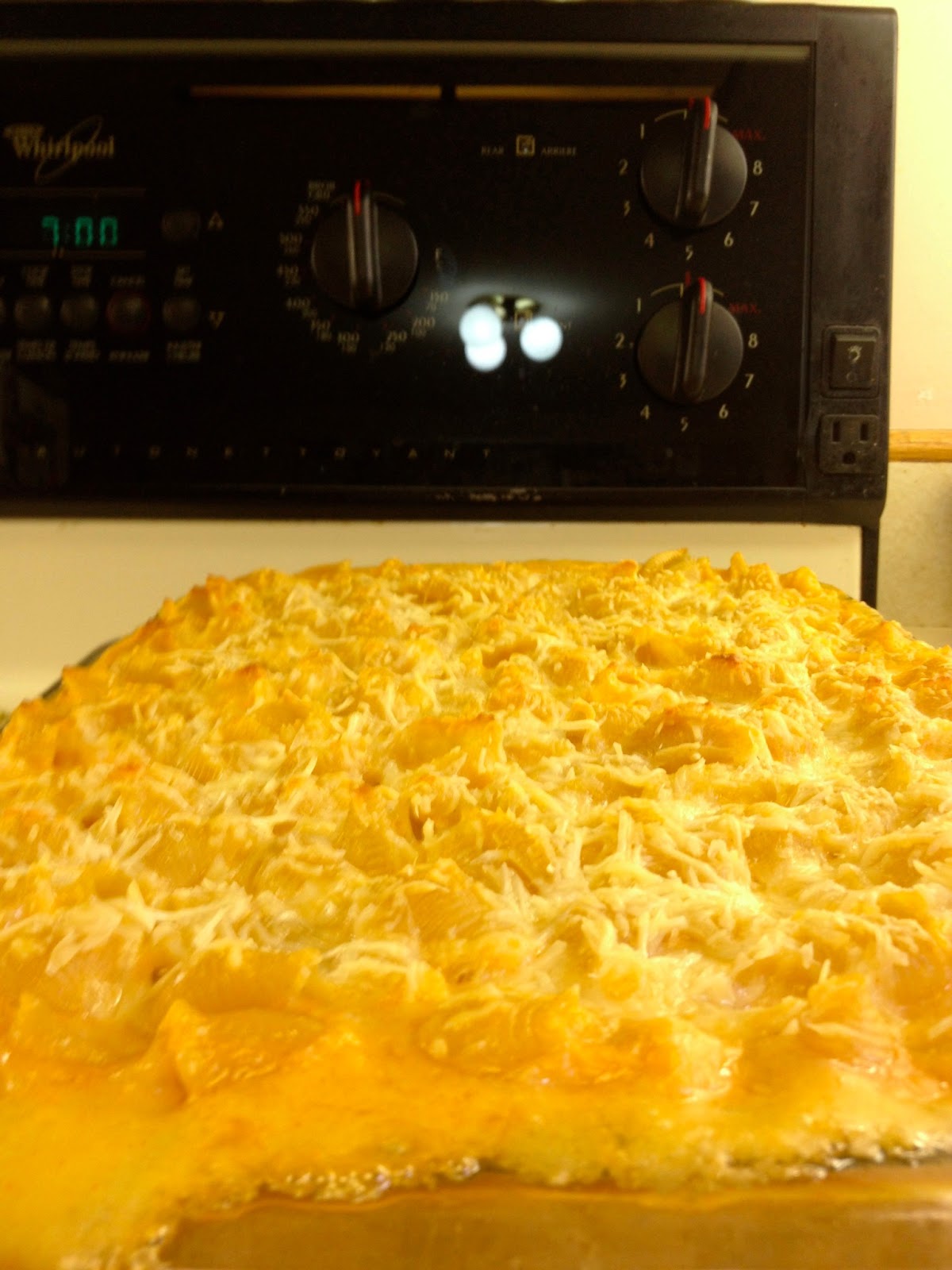
As I alluded to the last time I posted, I've been going out for dinner a lot over the last couple of weeks.  But the other night while staying with my parents I finally found a chance to cook.  The weather was cold and stormy, which called for something warm and bubbly: macaroni and cheese.

Like any good college student, I fell in love with macaroni and cheese in the form of Kraft Dinner, the radioactive orange meal in a box that contains more preservatives than dairy products.  As I grew older, however, I started to desire something that tasted less like sodium and orange number six.

The potential problem with homemade mac and cheese is one of money: good cheese is expensive, and good cheese is what adds flavour.  So I had to find another way to make this casserole taste delicious.....

I found the answer in a recipe by the fantastic Michael Smith.  You can use whatever pasta you have in the cupboard and, better yet, whatever cheese happens to be in your fridge (or on sale).  The flavour comes from the spices added to the sauce: garlic, paprika, cayenne, and dijon mustard (Michael Smith's secret weapon).

Ingredients
-1 pound of pasta (any kind)
-1/4 cup butter
-several cloves of garlic
-2/3 cup flour
-a big splash of white wine
-5 cups milk
-1 pound cheese (any kind)
-2 tablespoons dijon mustard
-2 tablespoons paprika
-cayenne pepper to taste

Directions

Optional step 0......for more flavour, use bacon.  Chop approximately one pound of bacon and toss into a thick bottomed saucepan over medium-high heat (if you add one cup of water, you can allow the bacon to gradually release it's fat and brown evenly without burning).  Cook until the bacon is nicely cooked; remove the bacon, but reserve the fat.

(If you go with the bacon step, omit the butter and use bacon fat instead.)

1) Cook the pasta according to package directions.  Drain (don't rinse...the start helps the sauce stick to the pasta) and set aside.

2) Melt the butter over medium heat.  Add the garlic and cook for several minutes.  Add the flour and stir with a wooden spoon until a smooth paste forms.  Continue cooking the roux for several minutes to add flavour.

3) Add the wine, and stir until the mixture becomes smooth again.  Slowly add the milk and switch to a whisk, stirring until the mixture is smooth.  Then cook a couple of minutes longer until the milk begins to thicken.

4) Stir in the cheese, dijon mustard, paprika, and cayenne pepper.  Stir the cooked pasta into the cheese mixture.  Pour everything into a 9x13 pan and bake at 350 degrees F for about 30 minutes (or until the cheese is bubbly).

For added flavour I like to sprinkle extra parmesan cheese across the top of my mac and cheese....
Then, as always.....enjoy!!


Sunday, 31 March 2013

Meatless March: Week 4

The week started out like any other...I did some schoolwork, went to yoga, and made myself a dinner that would provide me with plenty of leftovers.

I hadn't made pasta in awhile, so I decided to play around with something from the macaroni and cheese family.  The problem with classic baked mac and cheese (from the perspective of a person who watches what they eat) is the sauce...while delicious, it's not the healthiest thing around.  I'm always looking for a way to lighten up the recipe and have stumbled upon a foolproof plan: pureed vegetables.

Ingredients
-4 cups cauliflower florets (about 1/2 head cauliflower)
-1 medium onion, sliced
-2 cloves garlic, peeled
-4 cups penne
-2 cups milk
-1 tsp grainy mustard
-2 tsp fresh thyme (or 1/2 tsp dried)
-salt and pepper to taste
-1 cup grated Gruyere
-1 cup grated Parmesan

Directions
1) Preheat the oven to 375 degrees F.

2) Put the cauliflower, onion, and garlic in a steamer basket; steam until the cauliflower is tender (about 10-15 minutes).

At this point you can do one of two things.
-if you have a blender, transfer the cauliflower mixture to a blender.  Add milk and blend until smooth, then transfer to a large saucepan.
-if you are using an immersion blender, transfer the cauliflower mixture to a large saucepan.  Add milk and blend until smooth.

3) Cook the penne according to package directions; drain.

4) Add thyme, mustard, salt, and pepper to the cauliflower puree.  Cook over medium-low heat until it is hot but not boiling (about 3-5 minutes).  Add Gruyere and 1/2 cup Parmesan cheese, stir until melted.

5) Add the sauce to the pasta and stir to combine.  Transfer to an 8-inch square baking dish and sprinkle the remaining cheese on top.  Bake for 20-30 minutes (until the cheese begins to brown).

The plate is covered in veggies!
This meal was so delicious that I had it for dinner again on Monday night!

Tuesday night I stuck with the "plate full of veggies" theme and prepared a delightful Thai curry packed with enoki mushrooms, bok choy, and what asparagus I had left.  And, in the interests of doing things just a little bit differently, I decided to serve my curry with udon noodles rather than rice.

Another meal that earned a repeat performance the next night.
I had a tough time deciding what to eat on Thursday night.  On one hand, I wanted to keep up my record of not repeating recipes.  On the other hand, I'd had a busy day and was just not in the mood to get fancy in the kitchen.  I compromised: ravioli (which I keep on hand in the freezer for nights like this) with lemon brown butter and kale pesto (to prove that you can make something delicious on the fly).

Couldn't forget the garlic toast!
Friday I went out for dinner.  God bless Indian food...all of the vegetarian options are delicious!  I'm not going to lie though, there was more than one moment when all I wanted was some of the chicken tikka that my friend was chowing down on.

When the weekend arrived so did a challenge: feeding my parents.  They are carnivorous types, and I know that my father (in particular) wasn't necessarily giggly about the whole "meat free" idea.  Given that, I'm pretty sure they enjoyed what I cooked for them.

I started off with a variation on a meal I had made earlier in the month: eggs poached in marinara.  The changes I made were to make it a little heartier: I added some sauteed spinach to the sauce (which was in my freezer ready to go) and served it with polenta.

My father was sceptical, but after tasting agreed that it was delicious!
Sunday morning we went out to brunch at the resort restaurant where I was confronted with exactly how much I miss bacon.  I stuck to my guns though, and drowned my sorrows in a waffle with raspberries and creme anglaise (with a mimosa on the side).

Sunday evening (the month's last meatless meal!) we dined on a beautiful butternut squash and kale lasagna!

White sauce, gruyere and parmesan cheese, with pecans on top :)
And with that the month was over!  If nothing else, I hope that I've inspired you to give up meat one or two nights a week.  The options are just as delicious, they're easy to prepare, and going veggie is easy on the wallet.  And as always, if you want any of the recipes that I have not posted just let me know and I'm happy to share.

As for me, I'm having bacon with breakfast tomorrow..... :P

Saturday, 2 March 2013

Meatless March: Week 0.5

My first stretch of vegetarianism was just two days (Friday and Saturday), and I made it through with relative ease.

Friday evening found me out for a beer with friends, where I managed to avoid ordering a pound of chicken wings (mmmmm.....chicken wings) in favor of splitting a tower of beer.  However, after getting home late-ish I was then faced with the task of creating something to eat.......

Luckily, my somewhat obsessive compulsive personality was one step ahead, and I had some rice leftover from a meal earlier in the week.  Plan: veggie fried rice.  It was extremely easy (since the rice was already cooked) as well as inexpensive, since I used veggies that I already had on hand (broccoli stems, frozen peas, frozen corn, baby carrots, garlic, and green onions).  Delicious, filling, and ready in ten minutes.

Full of vegetable goodness!

I had more time on my hands Saturday, and so I decided to make something a little more involved.  This particular recipe is one that I made back in the fall semester for a potluck, and one that I have been since wanting to repeat: celery root, potato, and pear gratin.

Being as this was my second time around for the dish, I made some changes to the ingredients and method of preparation.  In what follows I will likewise share the recipe in a way that allows for you to make changes of your own...the steps are the same for any basic potato gratin recipe!

Ingredients
-1 small to medium celery root, sliced 1/4 inch thick
-1 or 2 medium potatoes, sliced 1/4 inch thick
-1 medium bartlett pear, sliced 1/4 inch thick
-2 cups milk
-2 garlic cloves, smashed
-1 tsp dried thyme
-1 cup gruyere cheese, grated
-2/3 cup parmesan cheese, grated

Room for change: the starch, the cheese, and the add-in.  In this recipe I used both celery root and potato...feel free to use one or the other (just adjust the quantities as needed).  As for cheese, feel free to use whatever you like or have on hand (I personally like gruyere for this recipe because it tastes beautiful with the pears).  And finally, don't limit yourself to additions like pear.  Feel free to layer in any number of other things (sauteed mushrooms, bacon, onion...the possibilities are endless).

Directions
1) Preheat oven to 400 degrees F.  Grease a medium casserole dish.
2) Combine cheeses in a small bowl, set aside.

**If you have chosen to use any additional add-ins, combine these in a separate bowl and set aside with the cheese.

3) Combine celery root, potatoes, garlic cloves, thyme, and milk in a skillet.  Simmer over medium-low heat for about 10 minutes (until the potatoes are just tender).
4) Using a slotted spoon, transfer half of the potatoes/celery root into the prepared casserole dish.  Sprinkle 1/3 cheese mixture over potatoes.  Transfer remaining potatoes/celery root to the casserole, sprinkle 1/3 cheese mixture.  Top with slices of pear and remaining cheese; pour milk over completed gratin.

**If you are using different additions, add them at the pear step in the previous instruction.

5) Bake for 25-30 minutes, until the potatoes are completely tender.  Let sit for at least 15 minutes before serving...then enjoy!

Cheesy gratin + salad + wine = a delightful Saturday night meal!